What Are the 2026 Top PUR Block Foam Types?
The 2026 PUR Block Foam market is moving beyond simple density comparisons. Buyers now examine cell structure, resilience, compression set, airflow, processing stability, and environmental performance. A block that looks uniform may still behave differently across its core, edges, and cut surfaces. That difference matters in mattresses, furniture cushions, acoustic panels, automotive interiors, and protective packaging.
Dr. John H. Saunders, a recognized polyurethane technology authority, emphasized a practical principle: “The structure of a polyurethane determines its properties.” This idea remains highly relevant when comparing 2026’s leading PUR Block Foam types. Conventional ether foam offers balanced comfort and moisture resistance. Ester foam provides stronger load support and improved resistance to some oils. High-resilience foam targets faster recovery and longer seating life. Viscoelastic foam responds slowly under pressure, creating a contouring feel. Flame-retardant and lower-emission grades also deserve closer attention, although performance can vary between suppliers.
This guide examines these major types through real manufacturing and application considerations. It looks at density, hardness, rebound, durability, airflow, cutting behavior, and quality consistency. Test data should guide decisions, not attractive product names. Some newer formulations appear promising, yet their long-term aging performance still needs more field evidence. That uncertainty is worth acknowledging. A foam can pass laboratory tests and still disappoint when exposed to heat, humidity, repeated loading, or uneven installation. The best 2026 choice will depend on the final application, not on one headline specification.
2026 PUR Block Foam Classification by Density and Cell Structure (ISO 845)
What Are the 2026 Top PUR Block Foam Types?
In 2026, PUR block foam is best classified through density and cell structure. ISO 845:2018 measures apparent overall density, expressed in kilograms per cubic metre. It does not define universal “low,” “medium,” or “high” density classes. In production practice, low-density foam often falls below 25 kg/m³, medium-density foam ranges from 25 to 45 kg/m³, and high-density foam exceeds 45 kg/m³. These bands are useful, but not absolute.
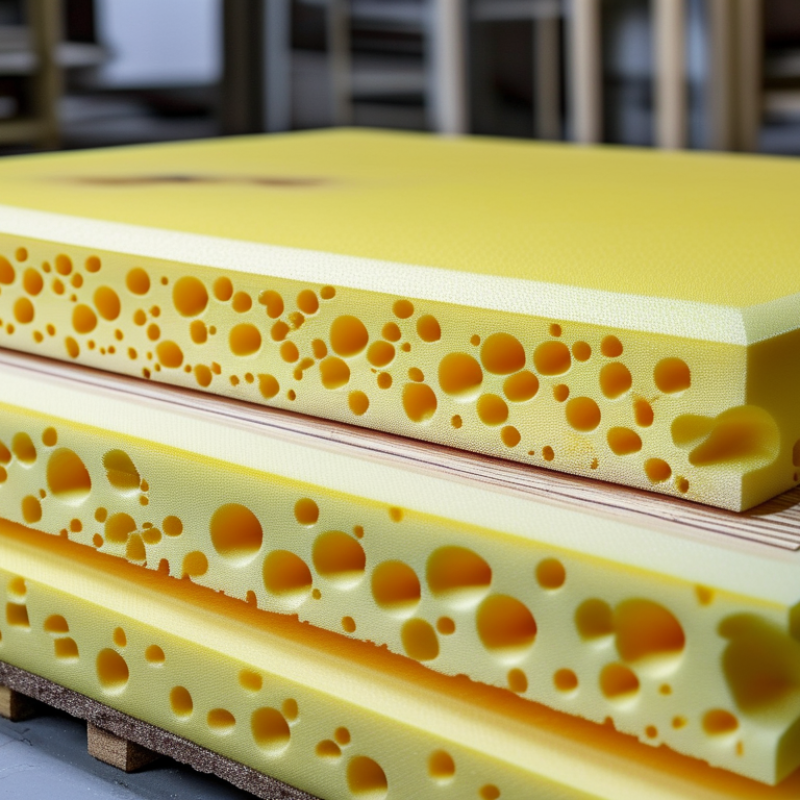
Open-cell PUR block foam contains connected pores. It feels softer, allows airflow, and supports cushioning or acoustic applications. Closed-cell foam has sealed pores, lower water absorption, and stronger insulation performance. A 35 kg/m³ open-cell block can compress more easily than a 30 kg/m³ foam with tighter cells. Density alone can mislead. Cell size, skin formation, hardness, and recovery should be tested together.
Grand View Research estimated the global polyurethane foam market at about USD 46.9 billion in 2023, with a projected 6.3% compound annual growth rate through 2030. Fortune Business Insights reported a larger market value because its scope and product coverage differ. The figures are not directly comparable. This matters when forecasting 2026 demand. For reliable purchasing, specify ISO 845 density, compression testing, cell structure, and tolerance limits. A visual cut sample helps, but it cannot replace laboratory testing.
High-Resilience PUR: 35–60 kg/m³ and ≥40% Ball Rebound
For 2026, high-resilience PUR block foam is defined less by density alone than by recovery performance. The practical target is 35–60 kg/m³ with ball rebound of at least 40%. This range supports seating, mattresses, and cushioning that face repeated compression. Grand View Research’s 2024 flexible polyurethane foam report identifies furniture and bedding as major demand areas. These applications require stable support, airflow, and controlled fatigue resistance.
Density gives the foam substance. Cell structure gives it movement. During production checks, technicians should measure rebound under consistent temperature, humidity, sample thickness, and ball conditions. ISO 8307 provides a rebound method, while ASTM D3574 covers flexible cellular polyurethane foam testing. A 42% rebound result can look strong, yet it may hide poor recovery after long compression. That matters beside a window seat or under a sleeper’s shoulder.
Watch the recovery curve.
Higher density does not automatically mean higher resilience. Formulation balance, cell openness, hardness, and processing stability can change the result. A block near 50 kg/m³ may feel supportive but still recover slowly if its cells are poorly connected. The 2024 market outlook from IMARC Group also links flexible foam growth with comfort-focused furniture and bedding demand. However, published market figures rarely capture factory variation. That is the uncomfortable part. Buyers should request batch-level density, rebound, hardness, and compression-set data, rather than trusting one catalogue value.
What Are the 2026 Top PUR Block Foam Types? - High-Resilience PUR: 35–60 kg/m³ and ≥40% Ball Rebound
Technical comparison of common polyurethane block-foam categories and their typical performance ranges
Typical specification ranges for flexible PUR block foam. Actual values vary with formulation, cell structure, curing conditions, and test method. | Foam type | Typical density
(kg/m³) | Ball rebound
(%) | Typical firmness
(ILD 25%, N) | Compression set
(% max., typical) | Key characteristics | Common applications |
| High-resilience PUR block foam | 35–60 | ≥40 | 80–180 | ≤8–12 | Fast recovery, high elasticity, supportive seating feel, and good fatigue resistance. | Premium seating, mattresses, automotive seating, office chairs, and sports cushioning. |
| Conventional flexible PUR block foam | 18–35 | 25–45 | 60–160 | ≤10–18 | Cost-efficient, versatile, and available in a broad range of firmness levels. | General furniture, packaging inserts, mattresses, cushions, and interior padding. |
| High-load-bearing PUR foam | 45–70 | 30–50 | 150–300 | ≤8–14 | Higher support factor and load capacity than standard flexible foam; less springy than HR grades. | Heavy-duty seating, vehicle components, support pads, and structural cushioning. |
| Viscoelastic PUR foam | 40–85 | 5–25 | 40–140 | ≤10–20 | Slow recovery, pressure distribution, temperature sensitivity, and low motion transfer. | Comfort layers, pillows, pressure-relief products, and specialized seating. |
| Combustion-modified flexible PUR foam | 25–45 | 25–45 | 70–180 | ≤10–18 | Formulated to meet specified flammability requirements; performance depends on the applicable regulation. | Public seating, transportation interiors, contract furniture, and bedding products. |
| Ether-based flexible PUR foam | 20–55 | 30–55 | 60–220 | ≤8–16 | Good hydrolysis resistance and useful resilience; suitable for humid or demanding environments. | Marine cushions, footwear, filtration supports, seating, and moisture-prone interiors. |
Measurement note: Ball rebound is commonly evaluated using a standardized ball-rebound method such as ISO 8307. ILD values are commonly reported using methods such as ISO 2439 or ASTM D3574, and should not be compared across different test procedures without checking the method and conditioning requirements.
Interpretation: A high-resilience grade is generally identified by rebound of at least 40% together with a density commonly within the 35–60 kg/m³ range; density alone does not determine durability, comfort, or load-bearing performance.
Viscoelastic Memory PUR: 40–100 kg/m³ and Slow-Recovery Behavior
What Are the 2026 Top PUR Block Foam Types?
Viscoelastic Memory PUR: 40–100 kg/m³ and Slow-Recovery Behavior
Viscoelastic memory PUR remains a key block-foam type for comfort-focused applications in 2026. Its density typically ranges from 40 to 100 kg/m³. Higher density often improves durability, but it does not guarantee better comfort. Formulation, cell structure, hardness, and processing history also matter. In practical evaluations, a 60 kg/m³ foam may feel more supportive than a denser sample.
The defining feature is slow recovery after compression. Pressing a hand into the surface leaves a visible impression for several seconds. This response helps distribute pressure across the body instead of creating one sharp contact point. Temperature changes the experience. In a cool warehouse, recovery can become noticeably slower. In a warm room, the same foam may feel softer and respond faster. That difference needs measurement, not guesswork.
Reliable evaluation should include density, indentation force deflection, compression set, tensile strength, and recovery time. Test pieces should rest before comparison. Otherwise, recent compression can distort the result. Airflow and cover fabrics also influence perceived softness. A common mistake is treating density as the whole specification. It is not. Small details matter.
Rigid PUR Blocks: 30–200 kg/m³ and λ≈0.020–0.030 W/m·K
What Are the 2026 Top PUR Block Foam Types?
Rigid PUR blocks in 2026 are mainly selected by density, thermal performance, and intended load. The common range is 30–200 kg/m³, while thermal conductivity typically falls near λ≈0.020–0.030 W/m·K. Lower-density blocks suit insulation inserts, pipe sections, and lightweight panels. Higher-density blocks provide better compression resistance for tooling, protective packaging, and engineered support parts.
Density alone does not define quality. A 60 kg/m³ block may insulate well, but it can deform under concentrated pressure. A 160 kg/m³ block usually handles loads better, yet it may cost more and offer slightly different thermal behavior. Closed-cell structure, curing control, moisture exposure, and surface skin thickness also matter. Small production differences can affect cutting accuracy and final conductivity.
In practical evaluations, I check the declared λ value against its test temperature and aging condition. Fresh foam can perform better than aged foam. That detail is easy to overlook. I also inspect block flatness, internal voids, and dimensional stability after temperature cycling. A specification sheet may look convincing, but real installation conditions can disagree. For cold-room insulation, the 30–80 kg/m³ range is often efficient. For heavy-duty fixtures or load-bearing inserts, 100–200 kg/m³ may be more appropriate. The best choice depends on pressure, humidity, thickness, and machining tolerances, not density alone.